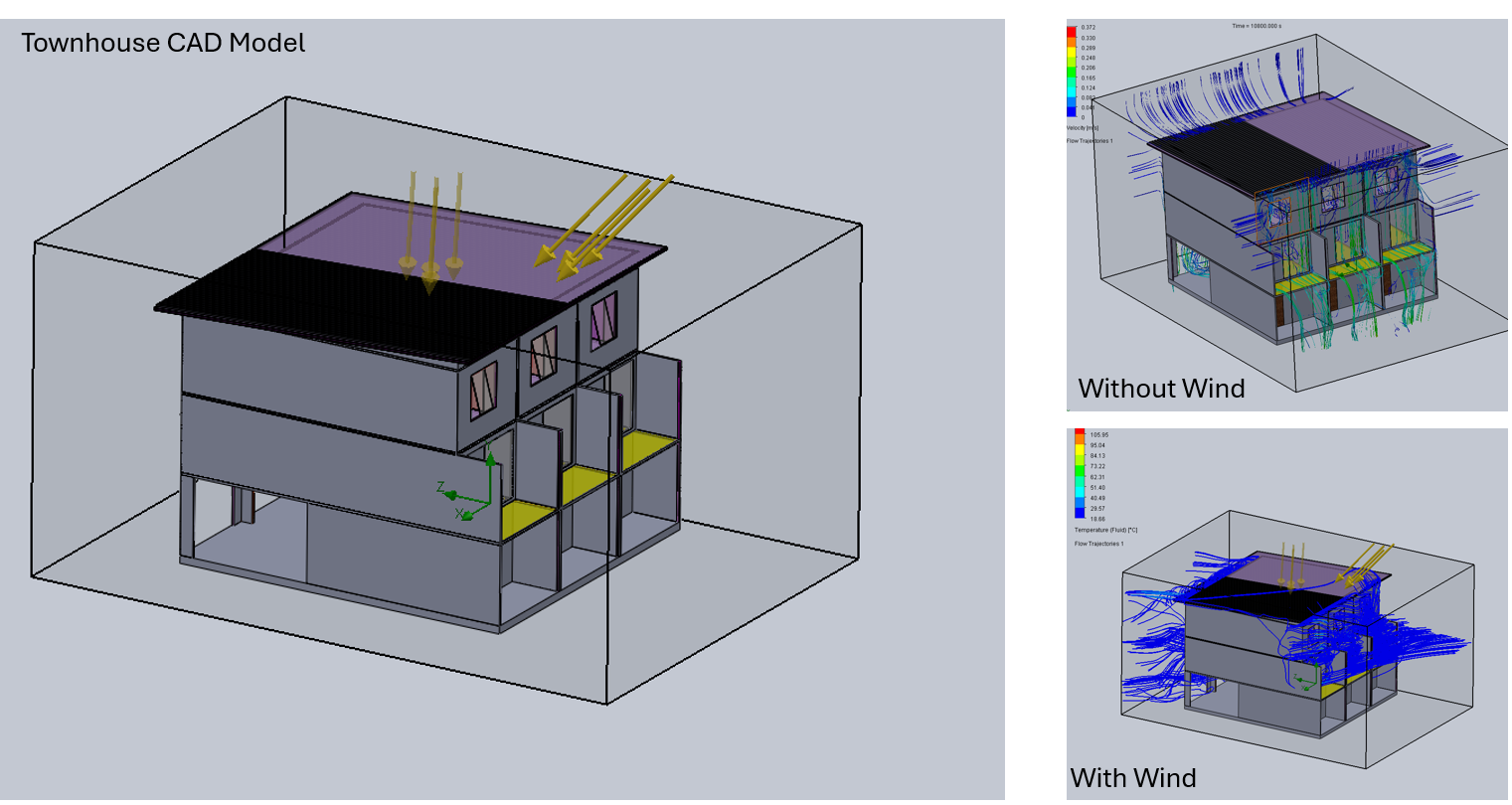
Over this past summer, many townhouse residents across New Zealand experienced uncomfortably high indoor temperatures. A recent article from The Spinoff (link here) explored how some modern housing designs may be poorly equipped to deal with rising summer heat.
There could be several contributing factors to this issue—such as over insulation, limited ventilation, large north-facing windows, and tightly packed urban layouts. While I don’t work in the building industry myself, I couldn’t help but notice parallels with thermal management challenges in electronic products. Intrigued by the problem, I decided to explore it further using computational fluid dynamics (CFD) simulation.
After consulting a friend in the building industry, I modelled a typical Auckland townhouse and ran a CFD simulation over the weekend to investigate how heat builds up during a hot summer day.
Key Modelling Details
The simulation included common architectural features:
- Exterior wall: Timber weatherboard
- Insulation: 70mm thick (R2.2, thermal conductivity ≈ 0.03 W/m·K)
- Roofing: Coloursteel
- Location: Auckland, New Zealand
- Building orientation: 40° northeast
- Date and time simulated: 12:00–15:00, 20 January 2025
- Weather conditions:
Ventilation settings:
- Second-floor windows open
- First-floor sliding door (with large glass panels) closed
- Rear windows open throughout
Preliminary Findings
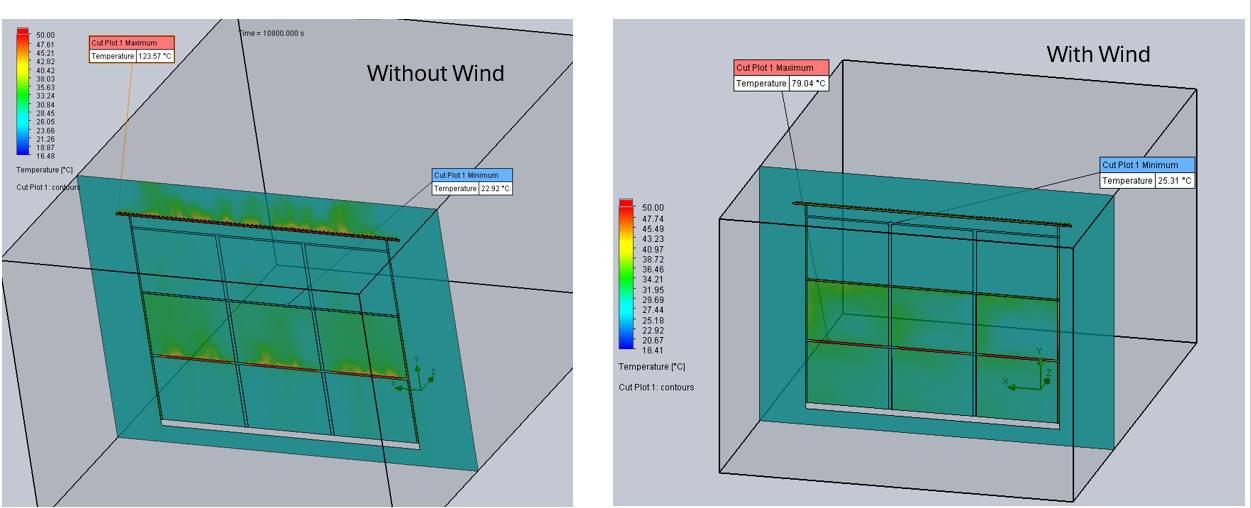
- Without wind:
The first-floor room temperature rose to over 40°C.
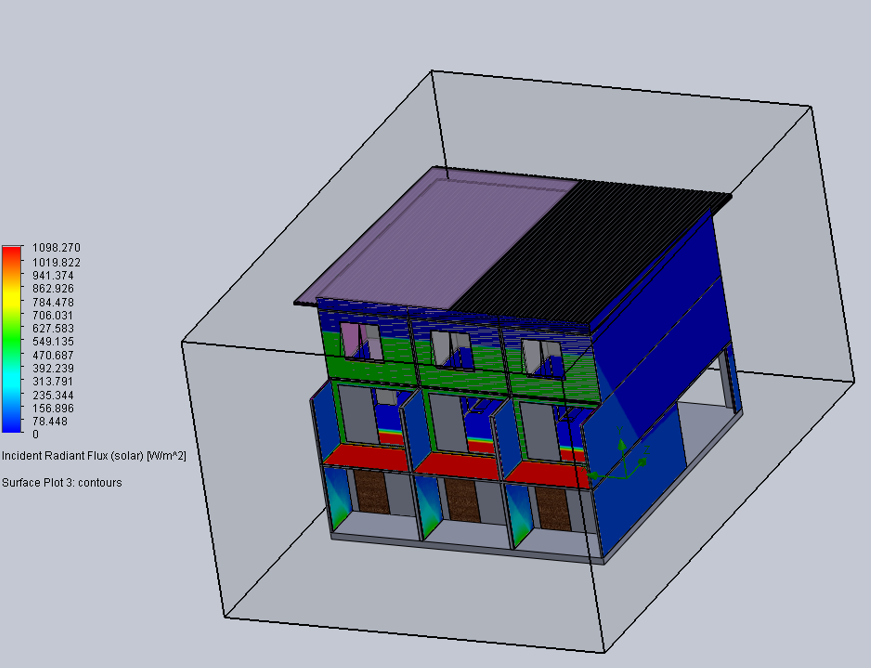
First-level surfaces reached more than 50°C due to the large sliding doors(windows)
Due to airflow through open windows, the second floor remained cooler, while the ground floor was coolest due to its lower exposure to direct sunlight.
- With wind enabled:
The first-floor temperature dropped significantly, demonstrating the cooling benefit of cross-ventilation.
These results highlight the critical role of passive and active ventilation, especially in urban centres where wind can be obstructed by surrounding buildings. Without proper airflow, internal temperatures can quickly exceed safe comfort levels—even on days with moderate outdoor temperatures.
I’ll be continuing this simulation to explore different ventilation strategies and see how they might be applied in real-world townhouse designs.